
 Written by
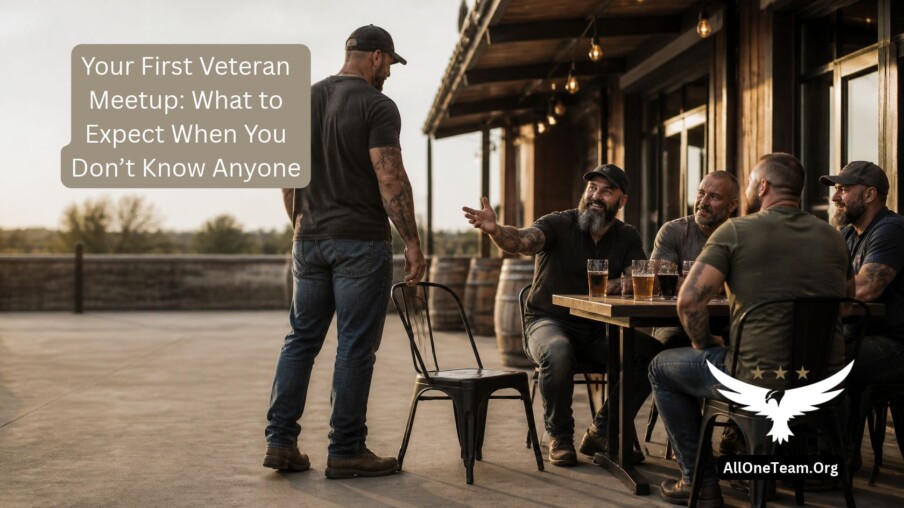
Your found Your First Veteran Meetup that sounds interesting. Maybe someone sends you a link. Maybe you notice a gathering nearby. Maybe you have been thinking about meeting other veterans for a while, and this looks like a reasonable place to start.
You check the date. Look at the location. Read the description twice.
Then come the questions.
Will everyone already know each other? Will you have anything in common? Will someone ask about your service before you have even figured out where to sit?
Can you bring your spouse? Is it okay to just listen? What if you get there and immediately want to leave?
Sometimes the hardest part of a meetup happens before you walk through the door.
You do not know the people yet. You do not know the rhythm of the gathering. And the event description, however welcoming, cannot tell you exactly how it will feel to arrive alone.
But your first visit does not have to be a major personal milestone. It can simply be a chance to see what the place is like, meet a person or two, and decide whether you want to come back.
You do not need a polished introduction.
You do not need an impressive story.
And you do not have to become the most outgoing person in the room.
What Does “Veteran Meetup” Actually Mean?
The phrase can describe very different gatherings.
One event might be a few people meeting for breakfast. Another might involve volunteering, professional networking, recreation, or a speaker. Some gatherings center on military experiences. Others bring veterans together around an activity that has little to do with their service.
That difference matters.
If you picture a quiet conversation and arrive at a crowded restaurant, the surprise alone may make the experience harder to enjoy. The same is true if you expect an activity and find a room arranged for introductions.
Before going, look for a plain description of what will happen.
Will people sit together or move around? Is there a schedule? Does the event have a host? Will someone lead a discussion, or are participants expected to start their own conversations?
If the description leaves those questions unanswered, ask.
“Hi, I’m thinking about coming for the first time. What does a typical gathering look like?” is enough.
You are not asking for special treatment. You are gathering the information you need to decide whether the event suits you.
You Don’t Have to Show Up Without a Point of Contact
There can be a big difference between walking into a room full of strangers and walking into a room where you know one person’s name.
That person does not have to be a friend yet.
It might be the organizer who answered your message or a volunteer who offered to meet you at the entrance.
A brief exchange beforehand can make arrival less uncertain:
“This would be my first event. Is there someone I should look for when I get there?”
If they give you a name, use it.
You can walk in and say, “I spoke with Jordan earlier. They said to find them when I arrived.”
Now you have a starting point. You do not have to stand by the door trying to work out who is in charge.
My advice is to keep it simple. I know how easy it is to run through every possible scenario before you even get there, but you don’t need to have every detail figured out before walking through the door. Ask what you need to feel comfortable, then give yourself a chance to take it all in.
You may meet people who recognize some of that hesitation because they’ve worked through similar feelings themselves. You don’t have to explain everything or pretend you’re completely at ease.
For me, the important step was showing up. I walked in, let the conversations happen, and gave myself a chance to connect. Those visits have led to several new friendships, and now we text almost daily. I couldn’t have planned those friendships in advance. I had to get there first.
Decide What You Want From This One Visit
You might eventually want close friendships, a regular activity, or a stronger connection to your local community.
Those are worthwhile hopes. They are also a lot to place on one afternoon.
For your first visit, choose something smaller.
Maybe you want to find out whether the atmosphere feels comfortable. Maybe you want to learn what the group does. Maybe you just want to introduce yourself to one person and stay long enough to have a conversation.
That can be the whole goal.
You do not need to leave with someone’s phone number. You do not need to tell a meaningful story or make plans for next month.
A first visit gives you information.
You might discover that you like the people but prefer a different activity. You might enjoy the gathering more than expected. You might decide it is not your kind of event.
Each of those outcomes tells you something useful.
Try not to turn attendance into a test you can only pass by having an amazing time.
Give Yourself a Simple Arrival Plan
Before leaving home, settle the practical details you can.
Check the address, parking information, start time, and whether you need to register. Find out whether there is a cost or anything you should bring.
If the event is inside a larger building, ask which entrance to use.
These details may seem minor until you are circling a parking lot or standing outside several identical doors.
You can also decide approximately how long you intend to stay.
That does not have to be a firm deadline. It is simply permission to approach the visit in a manageable way.
“I’ll go, meet the organizer, and stay for about an hour” may feel more approachable than “I’m going to spend my entire Saturday meeting strangers.”
If you enjoy yourself, you can stay longer when the event allows. If not, you already have a reasonable stopping point.
You do not owe anyone an endurance performance.
The First Introduction Can Be Short
“What should I say?” can become a bigger question than it needs to be.
You can start with your name and the fact that you are new.
“Hey, I’m Chris. This is my first time coming out.”
That gives the other person an easy way to respond.
If you want, add how you found the event or what interested you:
“I saw this group online and thought I’d check it out.”
You do not have to lead with your rank, occupation, deployment history, or years of service unless you want to.
Those details can become part of the conversation naturally. Or they don’t have to come up at all.
And if someone asks about your background, you can give the version you are comfortable sharing. A few sentences can be a complete answer.
An introduction is an opening, not an obligation to summarize your life.
You Can Listen Before You Talk
Some people enter a new setting and start conversations immediately.
Others prefer to watch, listen, and understand the room first.
Neither approach needs an apology.
You may want to hear what people talk about, notice how they interact, or get a sense of the gathering before joining in.
If someone invites you to speak, you can respond honestly:
“I’m glad to be here. I’m mostly listening today.”
At an informal event, participation might mean having one conversation, helping with a task, or simply spending time with the group.
If the gathering includes a structured discussion, ask the organizer in advance whether people can pass when invited to speak.
Knowing the expectations beforehand is better than feeling surprised in the moment.
You can be interested without being immediately talkative.
Your Service Does Not Have to Become the Main Topic
At a veteran gathering, military service may come up. That does not mean every conversation has to stay there.
You might talk about work, children, sports, music, home repairs, or where to get a decent breakfast.
Sometimes those ordinary topics provide the easiest starting point.
You also get to decide how much detail to share about your own experience.
A brief response can be both friendly and firm:
“That was a different chapter of my life. These days, I’m focused on building something new.”
Or:
“I was in (insert unit), but I’m happy to tell you what I’m working on now.”
You do not have to explain why a subject is personal.
And if you want to talk about service, that is fine too. The important thing is having room to participate without feeling that you must disclose more than you intended.
At one gathering, I met a guy and we started talking about something he was working through with his wife. We connected over real life – not our service histories. As we talked, we seemed to recognize something familiar in each other. A few words came up that confirmed we’d had similar military experiences, but neither of us needed to dig into the details. That was pretty much the beginning and end of the military talk. We went right back to the conversation that had brought us together in the first place.
You May Have Different Backgrounds and Still Enjoy Each Other
The people at a gathering may have served in different branches, eras, locations, and kinds of units.
Your experiences might overlap in some places and differ sharply in others.
You do not have to decide immediately whether someone fully understands your military background. You can begin with whether you enjoy talking to them.
Are they interested without interrogating you? Can you disagree without the conversation turning competitive? Do they leave room for experiences unlike their own?
Those questions may tell you more about the possibility of friendship than a matching service history.
You may connect with someone over something entirely unrelated to the military.
You may also meet someone whose perspective is different enough to be interesting.
Shared service can provide an opening. What you build from there can be much broader.
An Activity Can Take Pressure Off the Conversation
If unstructured socializing does not appeal to you, look closely at what people will actually do during the event.
A walk, workshop, service project, or recreational activity gives the gathering a shared focus.
You can ask a practical question. Work beside someone. Comment on what is happening in front of you.
There is less pressure to keep inventing conversation topics.
Even at a casual gathering, a small task can offer an entry point. You might ask whether the host needs help setting something up.
But helping is an option, not a price of admission.
You do not need to spend the entire event working because standing still feels uncomfortable. You are allowed to sit down, accept a cup of coffee, and be included without earning your place through usefulness.
If you prefer activity-based gatherings, that is valuable information about what suits you.
Choose accordingly.
Bringing Someone With You Is Worth Asking About
You may feel more comfortable attending with your spouse, a friend, or another veteran.
Before inviting them, check the event’s policy.
Most Veteran gatherings welcome families and supporters. Others are intended for a particular audience. There may also be registration requirements, capacity limits, or age restrictions.
Ask directly:
“Would it be okay to bring my spouse, or is this event just for veterans?”
There is no need to guess from a photograph or a general description.
If you bring someone, talk beforehand about what would make the visit comfortable for both of you.
Do you want to arrive together but meet people separately? Would you like them to stay nearby at first? How will you let each other know when you are ready to go?
A little coordination can prevent an awkward moment later.
And if you attend alone, you are not doing it the hard way or the wrong way. It is simply another way to begin.
Notice Whether the Welcome Matches the Words
An event can describe itself as welcoming. Your experience will tell you what that means in practice.
Look at the small interactions.
Does someone acknowledge you when you arrive? Does the host explain what is happening? When you join a conversation, do people make room for you?
You do not need everyone to become your friend. A few thoughtful gestures can be enough to make the setting approachable.
Also notice whether your boundaries are respected.
You should be able to decline a question, pass on an activity, or leave without being mocked or pressured.
A joke that lands badly does not necessarily define an entire group. But repeated disrespect is not something you have to tolerate to prove you can fit in.
Belonging should not require you to accept treatment you would otherwise recognize as unkind.
You are evaluating the gathering, too.
If the First Conversation Is Awkward, You Still Have Options
Perhaps you introduce yourself and the exchange stalls.
Someone answers your question but does not ask one back. A group continues a story you cannot follow. You run out of things to say.
That can be uncomfortable without meaning you have done anything wrong.
You can try another topic:
- “Have you been coming to these for a while?”
- “What got you involved?”
- “Are there other activities with this group?”
- “What do you like doing around here?”
You can also move on politely.
“Good meeting you. I’m going to grab some coffee” is a complete exit.
One flat conversation does not have to become your verdict on the whole event – or on yourself.
At the same time, you do not need to spend the gathering carrying every exchange. Look for someone who shows interest back.
Conversation works better when both people have room to contribute.
You Are Allowed to Leave
Maybe you have another commitment. Maybe you are tired. Maybe you have had enough conversation for one day.
You can go.
If practical, thank the host or the person who welcomed you.
“Thanks for having me. I’m heading out, but I’m glad I came.”
You do not need an elaborate excuse.
For activities involving transportation, assigned responsibilities, or group movement, clarify departure arrangements ahead of time. Leaving a coffee gathering is different from leaving halfway through an organized trip.
Otherwise, a respectful goodbye is usually all the explanation you need to offer.
Staying past your limit does not make the visit more successful.
Sometimes leaving while you still feel comfortable makes it easier to consider returning.
Judge the Visit After You Have Had a Little Space
On the way home, your first reaction might be relief that the unfamiliar part is over. It might be excitement that it was easier than you thought!
Give yourself time before deciding what the whole experience meant.
Then ask a few specific questions.
Did anyone make me feel welcome? Was there a conversation I enjoyed? Did the activity interest me? Was I able to be myself, even briefly?
Consider what felt uncomfortable, too.
Was it the ordinary awkwardness of being new, or something about how people behaved?
Those are different problems.
Unfamiliarity might ease with another visit. Repeated pressure or dismissiveness may be a reason to look elsewhere.
You can return without committing forever. You can try another event without rejecting the entire idea of community.
The useful question is not “Did I find my people today?”
It may simply be “Is there enough here to explore again?”
For Organizers: Make the First Five Minutes Easier
If you host veteran gatherings, think about what a newcomer has to figure out before they can relax.
They may need to locate the entrance, identify the host, understand the schedule, and work out where to sit – all while deciding how much to say about themselves.
Clear information can remove some of that guesswork.
Before the event, explain what will happen, who can attend, what it costs, and whom to contact with questions.
At the gathering, have someone available to greet newcomers and offer a straightforward introduction.
“Glad you made it. We’re getting started in about ten minutes. Let me show you where everything is” is more useful than leaving someone to navigate alone.
Ask before making a public introduction or sharing details about their service.
And give people ways to participate that do not depend on telling a personal story.
A welcoming event does not need to make a spectacle of welcoming someone. It needs to make arrival easier.
Your First Visit Can Be Ordinary
Perhaps you go to a gathering and nothing dramatic happens.
You have coffee. Learn a couple of names. Talk about traffic, work, or somebody’s overly ambitious home project.
You leave without a major revelation.
That does not make the visit meaningless.
The next time, you may recognize a face. Someone may remember your name. A conversation may pick up where it stopped.
Or you may decide to try a different setting.
I walked into a room full of strangers and didn’t know a single person. But I wasn’t starting from nothing. To me, we were already brothers and sisters through our shared military connection – we just hadn’t met yet. I introduced myself to people at different tables, joined a few conversations, and gradually found people I felt more comfortable around. I didn’t have to connect with everyone. I just had to give myself a chance to find a few people I could be myself with.
You do not have to walk through the door knowing exactly what you need from the people inside.
You can arrive curious, uncertain, quiet, or a little uncomfortable.
For one visit, that is enough.
The rest can develop one conversation at a time.