
 Written by
Generation Kill Military Terms and True Story Explained: True Story, Marines & Military Terms. Explore HBO’s Generation Kill, the real Marines behind the series, its military slang, and what the show reveals about leadership and the Iraq War.
Some war dramas introduce their characters through speeches about duty. Generation Kill introduces a world where the jokes are crude, the instructions are confusing, and the people expected to execute the mission have plenty of opinions about whoever planned it.
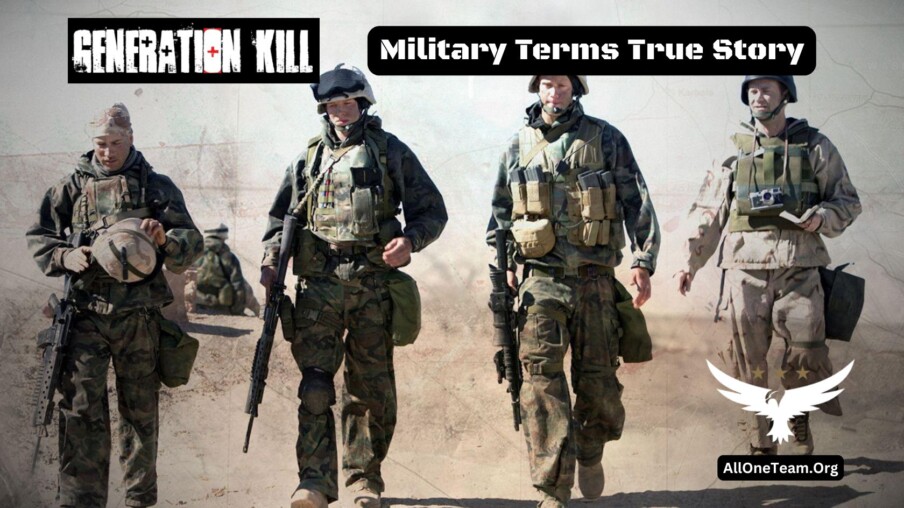
HBO’s seven-part miniseries follows Marines from the 1st Reconnaissance Battalion during the opening phase of the 2003 invasion of Iraq. Based on journalist Evan Wright’s reporting and his 2004 nonfiction book, it puts viewers alongside the Marines rather than above them, watching a campaign unfold through conversations, orders, arguments, and long stretches inside military vehicles.
For a veteran audience, the interesting question is not simply whether the weapons and uniforms look right. It is whether the relationships feel recognizable: the competent leader who earns trust, the official instruction that creates more questions than answers, and the joke that would make no sense outside the people sharing that moment.
For civilian viewers, there is another challenge: understanding the language.
That makes Generation Kill more than a war-show recommendation. It is a useful starting point for exploring military terminology, small-unit leadership, and the distance between how war is explained and how it is experienced.

What Is HBO’s Generation Kill About?
Generation Kill follows First Recon Marines as they prepare in Kuwait, cross into Iraq, and advance toward Baghdad. HBO describes the series as covering the first 40 days of the war. Its seven episodes move from invasion preparations to the Marines’ arrival in the Iraqi capital.
The focus is deliberately narrow. Rather than repeatedly cutting to national leaders explaining strategy, the story stays close to the people carrying out orders. Viewers learn what the Marines learn, encounter uncertainty when they do, and hear their competing interpretations of what is happening.
That perspective changes the experience of watching a war drama. An objective can sound urgent without its purpose being clear. A successful movement can produce another confusing assignment. A moment that looks decisive from a distance can feel improvised at ground level.
David Simon and Ed Burns, known for The Wire, adapted Wright’s account for television. The series premiered in July 2008. Its institutional focus – how organizations function, fail, and shape the people inside them – is central to its approach.
The result is less a procession of battlefield milestones than a close examination of people trying to do their jobs inside a much larger machine.
Is Generation Kill Based on a True Story?
Yes. Evan Wright embedded with Marines from the 1st Reconnaissance Battalion while reporting for Rolling Stone during the 2003 invasion. His reporting became magazine articles, then the nonfiction book Generation Kill, and eventually the HBO adaptation. Much of the series follows the Marines traveling in Bravo Company’s lead vehicle.
That reporting background matters. The story begins with observed people and events, not fictional characters invented to represent every possible military experience.
It also comes with limits.
An embedded reporter has extraordinary access to one part of a war, but that access is not the same as an all-seeing view. The television adaptation adds another layer: performances, selected scenes, and dramatic structure.
The best way to approach the show is as a dramatized account grounded in frontline reporting. It is not a documentary recording of every conversation, a complete history of the invasion, or a final judgment on every person depicted.
That distinction is especially important when considering its portrayals of leadership. A character’s actions can invite serious discussion without making the television version a complete biography of the real individual.
The Marines and Characters to Know
The cast is large, and learning the central personalities makes the military language easier to follow. The series’ main performers include Alexander Skarsgård, James Ransone, Lee Tergesen, Stark Sands, and Jon Huertas.
Brad “Iceman” Colbert
Alexander Skarsgård plays Brad Colbert, whose controlled manner provides an anchor amid the noise around him. His character illustrates a central leadership question: what does competence look like when the situation is unstable?
In the show, the answer is rarely a motivational speech. It is attention, restraint, technical knowledge, and an ability to keep people focused without pretending the circumstances are sensible.
Ray Person
James Ransone plays Ray Person, whose running commentary makes the vehicle feel like a workplace occupied by people who cannot escape one another.
His character helps explain the series’ unusual tone. Humor does not sit neatly between serious scenes. It runs through boredom, frustration, danger, and ordinary conversation. The jokes are part of the environment, not a signal that the stakes have disappeared.
Nathaniel Fick
Stark Sands plays Nathaniel Fick. His portrayal offers another angle on leadership: the officer positioned between instructions from above and the people expected to carry them out.
Watching Fick invites a useful distinction between passing an order along and taking responsibility for what that order means. The series repeatedly makes that gap uncomfortable.
Evan Wright
Lee Tergesen plays Wright, the reporter accompanying the Marines. His presence gives civilian viewers an entry point, but the show does not turn every unfamiliar expression into a classroom explanation.
That choice preserves the feeling of entering an established group. Wright must learn its habits, personalities, and language; the audience must do some of the same work.
Rudy Reyes
Rudy Reyes plays himself. Reyes and fellow Recon Marine Eric Kocher also helped prepare the actors through military training and technical guidance. Their involvement gave the production direct access to people familiar with the experience it was portraying.
That does not make every scene beyond criticism. It does help explain why the production’s physical behavior and interpersonal details receive so much attention in discussions of its authenticity.
Generation Kill Military Terms Explained
Understanding the vocabulary makes the series easier to follow, but the goal is not to memorize an entire military dictionary before pressing play.
See the entire list of Generation Kill Military Terms.
Start with a few terms that explain what the Marines do, how they communicate, and why apparently simple instructions can become complicated.
The explanations below are plain-English viewing aids, not substitutes for operational doctrine. For readers seeking formal terminology, the Marine Corps publishes a supplement to the Department of Defense’s military dictionary.
Recon
“Recon” is short for reconnaissance: gathering information about an enemy, terrain, or an area of operations.
In Generation Kill, First Recon’s identity matters because the Marines understand themselves as specialists. The series draws tension from the relationship between that identity and the missions they receive. Its episode descriptions repeatedly place the unit in a rapid advance involving changing objectives and uncertain conditions.
For viewers, the useful question is not simply, “Are these Marines capable?” It is, “How does this assignment fit what they understand their role to be?”
ROE: Rules of Engagement
Rules of engagement govern the circumstances and limitations under which forces may use force. Marine Corps instructional material treats ROE as an essential part of understanding military operations.
In the series, ROE become more than an acronym. They shape how Marines interpret armed people, possible threats, and instructions from their leaders. HBO’s episode guide explicitly identifies changing directions about armed Iraqis and frustration over orders as parts of the story.
For viewers, the important distinction is between identifying something suspicious and deciding that force is authorized. Those are connected decisions, but they are not identical.
Sitrep
“Sitrep” is shorthand for “situation report”: an update on what is happening. The term appears in the series’ dialogue, including a joke that applies military reporting language to celebrity gossip.
That joke works because an established communication habit has escaped its strictly official purpose.
Understanding the word helps viewers recognize both uses: the serious need for reliable information and the Marines’ habit of turning their professional vocabulary into comedy.
Klick
A “klick” is a kilometer. In the series, Colbert uses the term while describing the unit’s position relative to enemy lines.
It is a small vocabulary item with a practical payoff. Once the term is familiar, distance references stop interrupting the scene.
It also illustrates why military dialogue can initially sound denser than it is. Sometimes the unfamiliar expression describes an ordinary measurement, not a complicated tactical concept.
POG
“POG,” commonly expanded as “person other than grunt,” is slang used to distinguish non-infantry personnel from infantry personnel. It can carry a dismissive or insulting tone.
The term appears in Colbert’s dialogue during a scene emphasizing the unit’s self-image and frustration.
The important viewing point is that slang communicates attitude as well as classification. Hearing a label tells you something about the speaker and the relationship in that moment. It does not establish the actual value of someone else’s service.
“Stay Frosty”
In ordinary military slang, “stay frosty” means remain alert and keep your composure. It is also the title of the sixth episode.
The expression captures a recurring tension in the series: people can sound relaxed while taking a situation seriously.
Calm delivery should not be confused with indifference. Sometimes the point of the language is precisely to prevent anxiety from taking control.
Callsigns and Nicknames
The series uses both operational identifiers and personal nicknames. Those serve different purposes, even when a new viewer initially hears them as one confusing stream of names.
HBO’s episode guide refers to “Captain America,” while cast material identifies Evan “Q-Tip” Stafford. Wright also acquired the nickname “Scribe” while embedded with the Marines.
A useful viewing habit is to ask whether a name identifies someone’s function or expresses how the group sees that person. The distinction helps explain both communication and unit culture.
Why the Slang Matters Beyond Definitions
A dictionary entry can tell you what a word means. A scene reveals what someone is doing with it.
That difference is essential to Generation Kill. The same professional vocabulary can deliver an instruction, signal belonging, mock authority, or turn frustration into a joke. The show’s sitrep exchange is a compact example: official language becomes a way to make an absurd conversation sound briefly official.
The language also creates an inside and an outside. Experienced members of the group do not have to explain every reference. Newcomers do.
For civilian viewers, that can feel exclusionary at first. Yet explaining every term immediately would change the atmosphere. The Marines would stop sounding like people talking to one another and start sounding like characters performing an orientation briefing.
Learning the terminology helps, but listening to tone matters just as much. A correct definition cannot, by itself, tell you whether a line expresses respect, irritation, affection, or contempt.
Why Generation Kill Feels Authentic
The series’ reputation for authenticity rests partly on its source material and the participation of real Recon Marines. Reyes and Kocher helped train the actors, and reporting on the production highlights the attention given to mannerisms, performances, and military detail.
But equipment alone cannot make a military drama convincing.
The more revealing test is whether people seem to occupy an actual working relationship. Who gets listened to? Who has to repeat an instruction? Who can make a joke without undermining the task? Who creates extra work for everyone else?
Generation Kill builds much of its effect through those questions. Its conversations can be petty, funny, offensive, perceptive, or several of those things at once.
Military-focused coverage has also emphasized the series’ portrayal of shifting missions, leadership problems, camaraderie, and gallows humor. Those elements help explain its appeal beyond battlefield spectacle.
None of that means every veteran will recognize their own experience. This is a specific unit, campaign, and period. Authenticity is most useful here as a discussion about particular details – not a claim that one television series speaks for everyone who served.
Leadership Is the Story Beneath the Story
One useful way to watch Generation Kill is as a study of trust.
Formal authority is visible. Trust has to be inferred from behavior.
The series asks viewers to notice whether leaders understand the situation, communicate clearly, and recognize the consequences of their decisions. It also shows how uncertainty and changing mission requirements can erode confidence within a unit. Military coverage of the show identifies that erosion of trust as one of its central concerns.
The most interesting leadership moments are therefore not always the loudest. They can involve restraint, clarification, or a refusal to let pressure become carelessness.
This makes the series valuable discussion material without turning it into a leadership manual. A dramatized scene can raise a question worth asking even when it cannot supply every fact needed to judge the historical decision.
That distinction keeps the conversation useful: examine the behavior presented, recognize the limits of the account, and resist treating confidence as proof of competence.
Dark Humor Does Not Make the War Harmless
The humor is one of the show’s defining features, but it is not gentle. The Marines’ conversations include offensive language and attitudes alongside fear, loyalty, irritation, and moments of insight. Contemporary discussion of the series noted those contradictions rather than presenting its characters as uniformly admirable or uniformly cruel.
Viewers do not have to approve of every remark to understand what the show is depicting.
Nor does describing something as military humor settle every question about it. A joke can express closeness while still being ugly. It can release tension without resolving whatever caused the tension.
The series is strongest when those contradictions remain visible. Laughter does not prove that people are untouched by events. Professional competence does not automatically produce moral clarity. Caring for someone beside you does not guarantee understanding of everyone outside the vehicle.
Treating the dialogue as evidence of complicated people is more productive than turning it into either a collection of inspirational quotes or a blanket defense of everything said.
What the Marine Centered Perspective Leaves Out
The show’s close viewpoint is both its strength and its limitation.
Following the Marines produces immediacy. It also means viewers should not mistake their access to those Marines for equivalent access to Iraqi lives.
HBO’s episode summaries describe encounters involving armed Iraqis, prisoners, villages, and Baghdad. These encounters belong to the story, but the narrative remains centered on the American unit.
A responsible reading keeps that imbalance in view. Confusion inside a vehicle and consequences outside it are not competing realities; both can exist at once.
The series can help viewers examine uncertainty, restraint, and the effects of military decisions. It cannot substitute for Iraqi accounts or a broader history of the invasion.
That is not a reason to dismiss its perspective. It is a reason to understand precisely what kind of perspective it offers.
Generation Kill Episode Guide
The miniseries consists of seven episodes, in this order:
- “Get Some”
- “The Cradle of Civilization”
- “Screwby”
- “Combat Jack”
- “A Burning Dog”
- “Stay Frosty”
- “Bomb in the Garden”
The first episode establishes the Marines preparing in Kuwait. Subsequent episodes follow the advance, changing assignments, and growing friction, with the finale bringing Bravo to Baghdad.
For first-time viewers, the early density of names and jargon is part of the adjustment. Focus initially on the central people and their relationships. The organizational picture becomes easier to understand once those personalities are familiar.
Frequently Asked Questions About Generation Kill
Is Generation Kill a documentary?
No. It is a dramatized HBO miniseries based on Evan Wright’s nonfiction reporting and book. Its real-world foundation is important, but it should not be confused with unedited documentary footage.
Which military unit does it follow?
The series follows Marines from the 1st Reconnaissance Battalion during the 2003 invasion of Iraq, with much of the narrative centered on Bravo Company’s lead vehicle.
Does Rudy Reyes play himself?
Yes. Reyes portrays himself and helped prepare the actors alongside Eric Kocher. Their participation is one reason discussions of the production frequently emphasize its military detail.
How many episodes are there?
There are seven episodes in one miniseries, beginning with “Get Some” and ending with “Bomb in the Garden.”
Should you read the book before watching?
Neither order is necessary for following the story. The book provides Wright’s original nonfiction account; the adaptation presents that material through performance and visual storytelling. Reading and watching together offers a way to examine how a reported account changes when it becomes television.
Watching Beyond the Acronyms
The terminology opens the door, but the relationships make Generation Kill worth discussing.
Once “recon,” “ROE,” and “sitrep” stop sounding unfamiliar, other questions become easier to hear. Who understands the assignment? Who has earned confidence? What happens when an instruction is clear but its purpose is not?
Those questions connect the series’ language to its larger concerns. Its military vocabulary is not decoration layered over an action story. It helps reveal hierarchy, identity, uncertainty, and the ways people make a difficult environment temporarily livable.
The most rewarding viewing approach is to learn enough terminology to follow the conversation – then pay attention to what the conversation reveals.